Imagine it. Design it. Build it.
A senior project that is going for a patent.
Parker Lauders and Kade Dancy built a working refreshable braille display for their senior capstone. It has been shown at the Ohio Statehouse, and they are pursuing a patent.
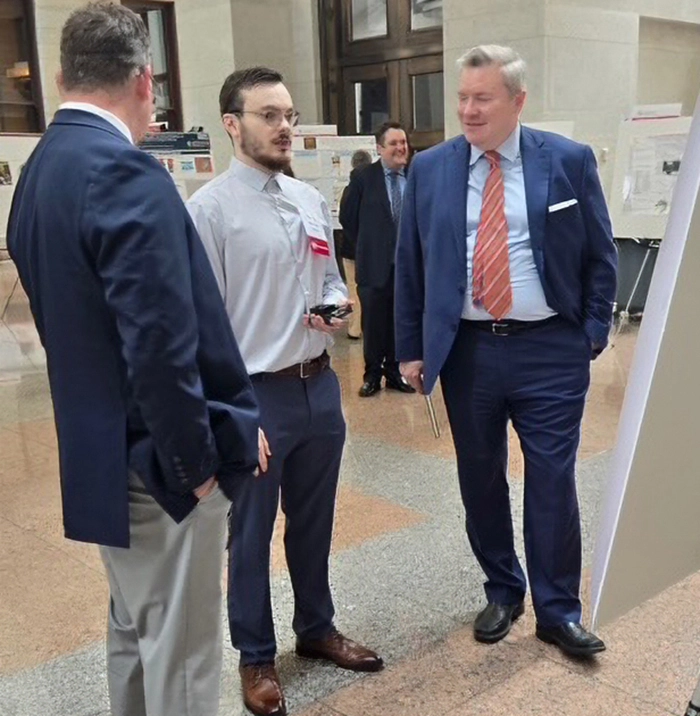
Parker Lauders displaying his research at the Ohio Statehouse
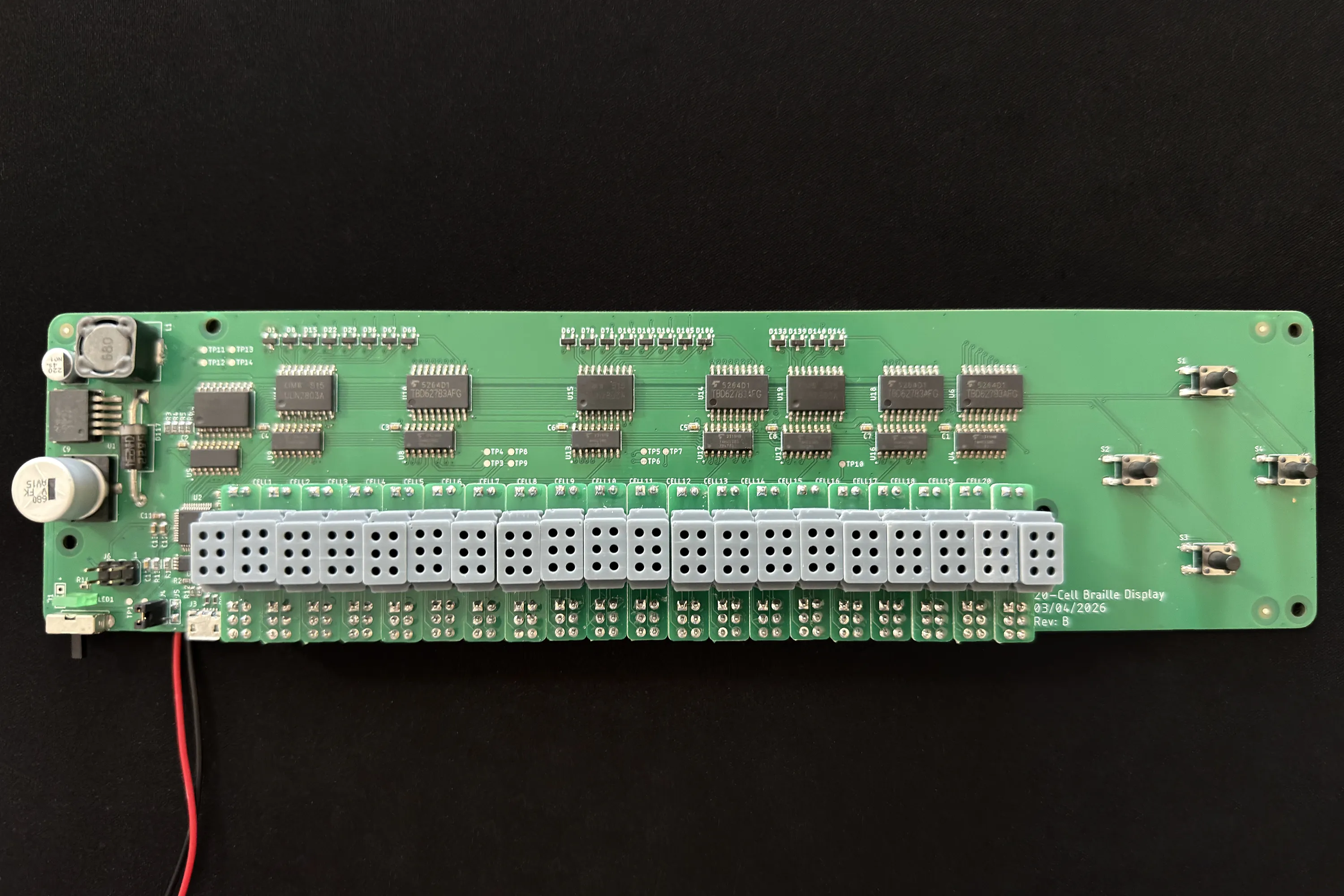
Closeup of a refreshable braille display prototype built by Shawnee State Computer Engineering Technology students Parker Lauders Kade Dancy
It started with an idea.
Parker Lauders had the idea during his first year at Shawnee State: a reading device that would make information accessible to people who are blind or have low vision, in the ordinary places where information is posted and then changed.
Three years later, he and Kade Dancy built it.
What they actually built.
For their senior capstone in Computer Engineering Technology, the two designed, built and programmed a fully functional electronic braille display — refreshable technology that presents information through mechanically raised and lowered dots. The design is deliberately simple and output-focused, which makes it practical in public spaces: restaurants, museums, information kiosks.
“We wanted to create something that makes information more accessible in everyday environments,” Lauders said. “Restaurants, for example, often have to reprint menus multiple times a year. With a device like this, you can upload new content without having to recreate a braille menu each time.”
“Being able to build a circuit, write the code, and see it actually function is what made everything click for me.”
Parker Lauders
Computer Engineering Technology
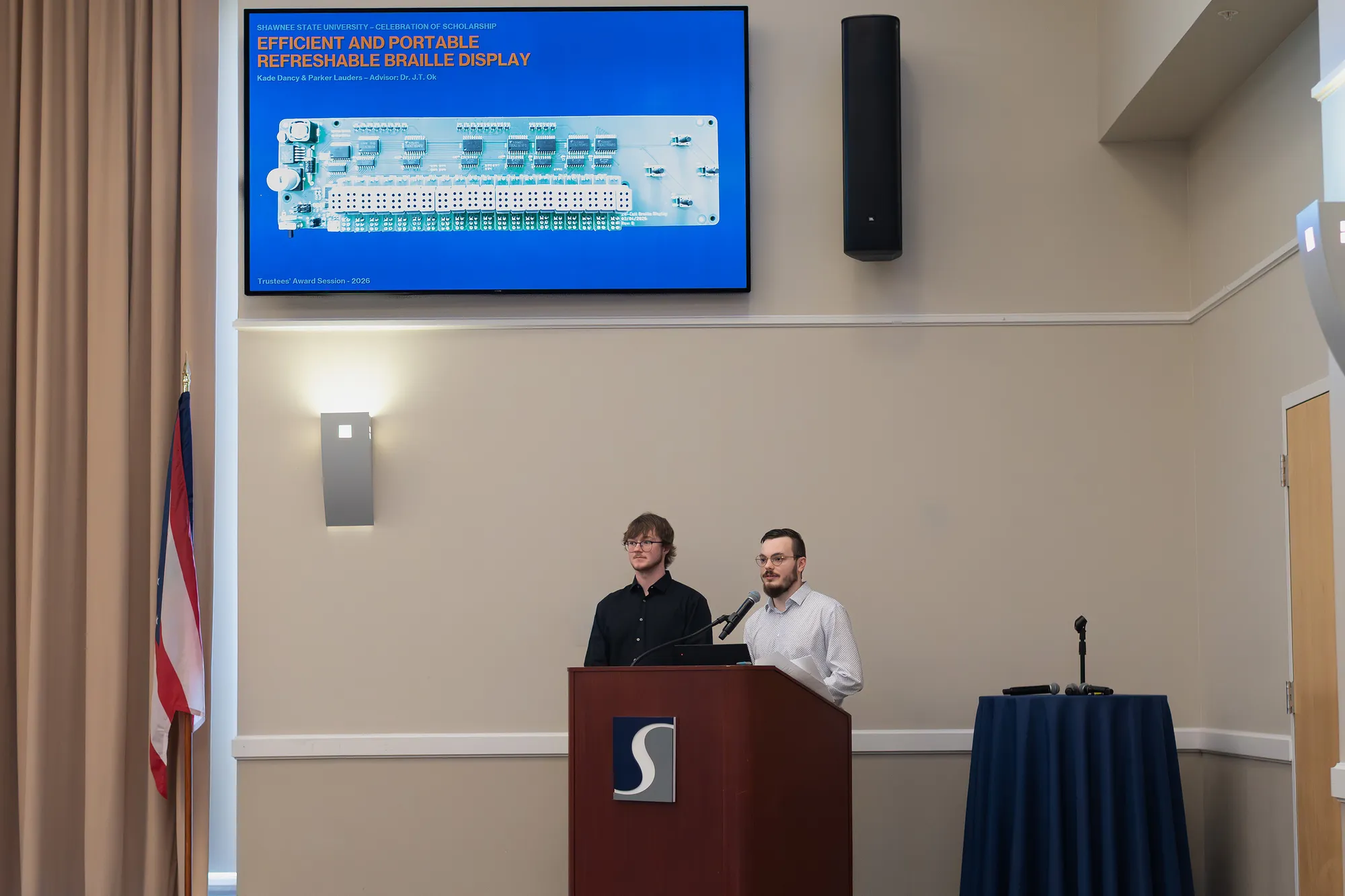
Kade Dancy (left) and Parker Lauders (right) presenting their research to the Shawnee State Board of Trustees
Imagine it. Design it. Build it.
That four-year arc — idea as a freshman, working prototype as a senior — is not an accident. It is the Imagine, Design, Build philosophy that runs through the Theoretical and Applied Computing programs at Shawnee State. From the first year, students are asked to imagine a solution to a real problem, develop a technical design and build the working product.
“Parker and Kade’s project perfectly illustrates the ‘Imagine, Design, Build’ philosophy,” said R. Duane Skaggs, Theoretical and Applied Computing programs coordinator. “They recognized a real issue related to limited or out-of-date information available for vision-impaired people and, using concepts from nearly every course in the Computer Engineering Technology program, designed and built a device that can be used in a wide variety of settings.”
“We do a lot of hands-on work from the start,” Lauders said. “Being able to build a circuit, write the code, and see it actually function is what made everything click for me.”
“Working on this project has been a deeply rewarding experience that has allowed me to apply my skills developed at Shawnee State University to a real-world accessibility issue,” Dancy said. “It’s been a privilege to help develop an affordable device for the benefit of others.”
“Using concepts from nearly every course in the Computer Engineering Technology program, they designed and built a device that can be used in a wide variety of settings”
R. Duane Skaggs
Theoretical and Applied Computing programs coordinator
It did not end at graduation.
The project did not end at graduation. The two are refining the hardware, working to bring manufacturing costs down and planning to pursue a patent. The device has been showcased at the Ohio Statehouse.
Both had jobs waiting. Lauders went into firmware engineering at the company where he interned. Dancy started as a project coordinator at Advance CNC Machining.


You won’t graduate without doing the work.
Starting with students who entered in fall 2026, every Shawnee State undergraduate completes at least one approved hands-on experience before they graduate. It is a requirement, not a recommendation.
Learn more about Experiential Learning at SSU