Radiologic Technology
This program is now offered at Adena Health’s PACCAR Medical Education Center, giving southern Ohio students a flexible, affordable path to healthcare education. Learn More
Train as a radiographer through Shawnee State's JRCERT-accredited program — with early, hands-on clinical experience at affiliated hospitals and a clear path to ARRT certification.
Program Overview
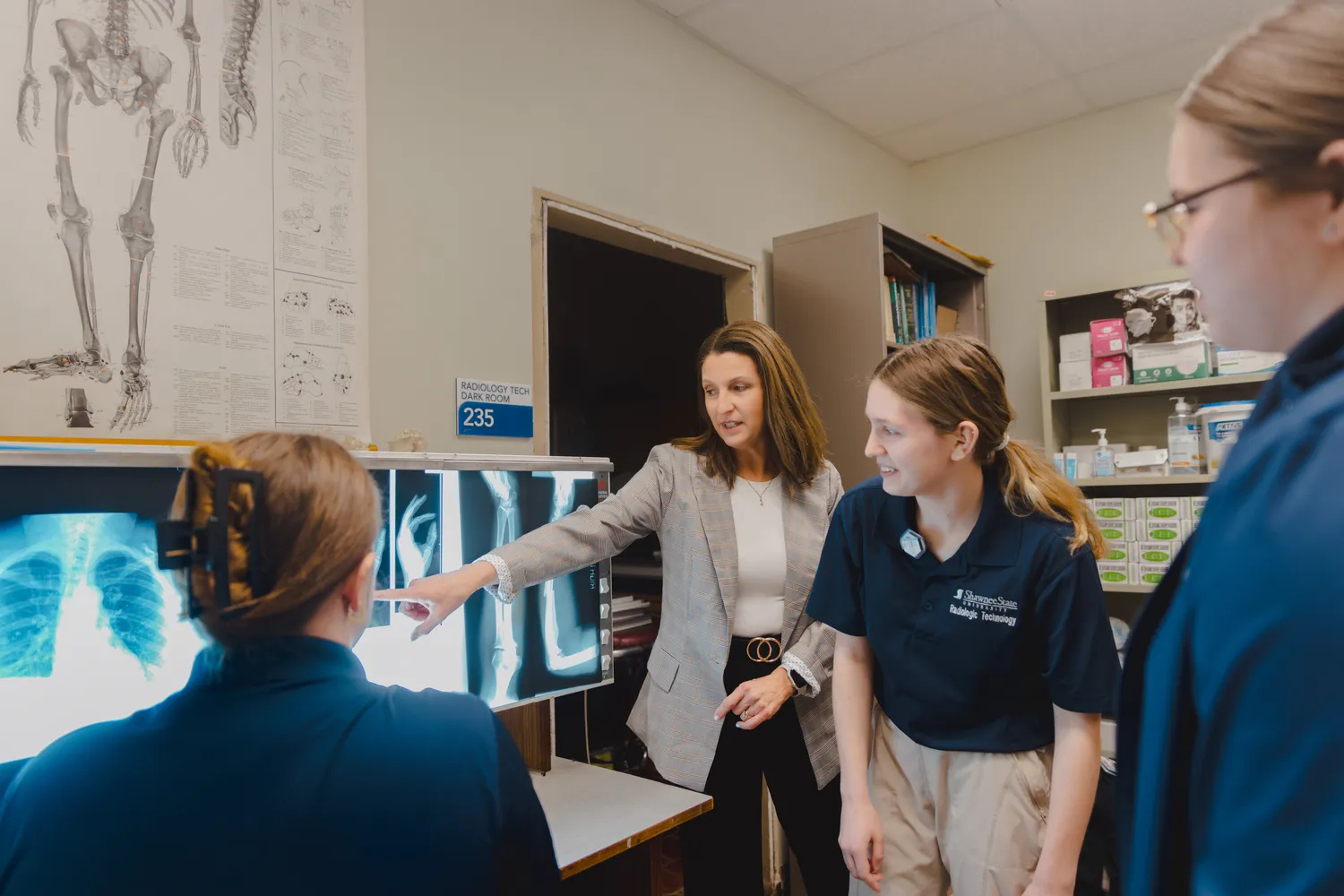
Step into a high-demand field with Shawnee State University’s radiologic technology program. Our Rad Tech Associate's Degree prepares students to become skilled radiographers who play a vital role in diagnosing and treating patients through medical imaging.
At SSU, we make career preparation personal. You’ll gain the technical training and clinical experience needed to succeed from day one on the job. From day one, you’ll have access to expert faculty, one-on-one advising, and a support system committed to helping you succeed—in class, in your clinical rotations, and in your career.
What is a Radiologic Technologist?
Radiologic Technologists are a part of the medical team and provide diagnostic images for medical diagnosis. The technologists work closely with radiologists and other physicians to provide medically necessary procedures to aid in the diagnosis of many pathologies and diseases. Radiographers, as they are sometimes referred to, provide adequate positioning and appropriate exposure techniques to offer quality diagnostic images with the lowest exposure dose to the patient. Students are provided knowledge on anatomy, positioning, exposure factors, radiation safety practices while learning high quality patient care.
Radiologic Technologists have a variety of career opportunities from working in a physician’s office to a fast-paced radiology department where demanding emergency services are required. Technologists can also work at urgent care facilities and surgery centers. Students in the program will gain experience in many different aspects of radiography opportunities.
There are also a variety of advanced imaging modalities that technologists may choose to specialize in that include: Computed Tomography, Magnetic Resonance Imaging, Mammography, Cardiovascular Radiography, Interventional Radiography, Nuclear Medicine, and Sonography. Currently, the program offers structured education in Computed Tomography, but does not offer formal education in any other advanced imaging modality.
For more information about each modality, please visit the American Society of Radiologic Technologists webpage
Career Outcomes
How to Apply
-
Start your application
Free, takes about 15 minutes.
-
Send transcripts
Have your high school guidance counselor send them to admissions@shawnee.edu
-
Send Admissions your ACT/SAT scores
If you have a copy of your report, email it to admissions@shawnee.edu. Your high school counselor may also be able to include your ACT/SAT score on your transcript. You may also contact ACT or College Board to have your scores officially sent to Shawnee State. If you listed Shawnee State at the time that you took your test, we will receive your scores automatically.
-
Submit the Selective Admission Application
Submit before the deadline to be considered.
-
File the FAFSA
School code 009942. Required for Free Tuition.
-
Get your decision
Most decisions in under 7 days.
Admission Requirements
Radiologic Technology is a selective admissions degree. Please review the admissions requirements below.
See program admission requirements
If you have any questions regarding the application process please contact:
Selective Admissions Team
Phone: (740) 351-3187
Email: chhs@shawnee.edu
At A Glance
Radiologic Technology
Degree
A.A.S.
Format
On campus, full-time, cohort
Length
6 semesters (including 2 summers); typically 2 years
Class Size
12:1

Why Study Radiologic Technology at Shawnee University
JRCERT-accredited curriculum that meets national standards and prepares you for the ARRT certification exam.
Hands-on clinical rotations at affiliated hospitals and medical centers throughout southern Ohio, starting early in the program.
Small cohorts with personalized faculty support — you progress through the program with the same group of classmates.
Industry-standard equipment in the classroom, so the imaging tools and techniques you learn on are the ones you'll use on the job.
Strong job placement history and competitive starting salaries in hospitals, outpatient clinics, and imaging centers.
Coursework runs in a structured sequence across six semesters, including two summers. Classroom instruction is paired with clinical education from early in the program.
- Anatomy and physiology
- Medical terminology
- Patient care
- Radiographic procedures and positioning
- Imaging equipment and image production
- Radiation protection
- Clinical education at affiliated hospitals
Clinical rotations are scheduled at affiliated hospitals, medical centers, and outpatient imaging facilities across southern Ohio. You'll perform radiographic procedures under the supervision of licensed technologists and faculty, building real-world experience that lines up with ARRT competency expectations.
By graduation, you'll be able to:
- Perform diagnostic radiographic procedures safely and accurately
- Demonstrate professional and ethical behavior in clinical settings
- Communicate effectively with patients, peers, and healthcare providers
- Apply knowledge of anatomy, patient care, and radiographic science
- Sit for the ARRT certification exam to become a registered radiologic technologist (R.T.)
This program is now offered at Adena Health’s PACCAR Medical Education Center, giving southern Ohio students a flexible, affordable path to healthcare education.
Graduates work as registered radiologic technologists in:
- Hospitals
- Outpatient clinics and imaging centers
- Physician offices and urgent care
- Mobile imaging services
- Advancement into CT, MRI, mammography, or interventional imaging through post-primary certificates
Demand for credentialed radiographers is steady across southern Ohio and the broader region.
A graduate may enter one of these one or two year programs in Radiologic Technology,- Nuclear Medicine Technology
- Radiation Therapy Technology
- Diagnostic Medical Sonography
- Students will demonstrate proper positioning skills in the laboratory setting.
- Students will demonstrate proper positioning skills in clinical situations.
- Students will demonstrate proper selection of technical factors.
- Students will utilize radiation protection.
- Students will demonstrate written communication skills.
- Students will demonstrate oral communication skills.
- Students will perform non-routine procedures effectively.
- Students will identify errors and seek corrections in radiographic images.
- Students will demonstrate the value of life-long learning by actively seeking additional certification or education and continuing to be active members in the field.
- Students will understand the importance of professional and ethical conduct in the clinical setting.
- Students will demonstrate professional and ethical conduct in the clinical setting.
Free Tuition and Financial Aid
Shawnee State's tuition is among the lowest in Ohio, and the Shawnee Advantage Tuition Guarantee keeps your rate flat for four years. Scholarships including Choose Ohio First and the Pell-Eligible Free Tuition Program may also apply.
See if you Qualify for Free Tuition
Ohio students can apply to receive a $1,500 scholarship up to full-tuition when you apply and are accepted.
Learn More about Choose Ohio FirstRadiologic Technology Frequently Asked Questions
Graduates are eligible to apply for the American Registry of Radiologic Technologists (ARRT) certification exam. Passing the exam makes you a registered radiologic technologist (R.T.).
Yes. Because of clinical training, the program runs full-time during daytime hours across six consecutive semesters.
Clinical rotations happen at affiliated hospitals, medical centers, and outpatient imaging facilities throughout southern Ohio. Faculty coordinate your placement.
R.T.s perform diagnostic imaging — positioning patients, operating X-ray equipment, applying radiation safety, and producing the images physicians use to diagnose and treat patients.
Mission Statement
The Radiologic Technology Program prepares students to be professional radiologic technologists who are life-long learners and responsible to the future of the radiology profession and technological advances.
Program Goals
- Students will be clinically competent in the Radiologic Technology field.
- Students will demonstrate effective communication skills.
- Students will demonstrate critical thinking skills in Radiologic Technology situations.
- Students will demonstrate professionalism in the Radiologic Technology field.
Program Handbook
Program and Clinical Handbooks are posted by class year. Review your cohort's handbook for policies, clinical procedures, and academic expectations.
Accreditation
The program is accredited by the Joint Review Committee on Education in Radiologic Technology (JRCERT)
20 N. Wacker Drive, Suite 2850
Chicago, Il 60606-3182
(312) 704-5300, fax: (312) 704-5304
Website: www.jrcert.org
Email: mail@jrcert.org
The program was awarded the maximum accreditation of 8 years in 2018.
View Program Effectiveness Data (PDF)
View JRCERT Accrediation Award Letter (PDF)
For more information about the program and accreditation information, please use the following link: jrcert.org/programs/shawnee-state-university/
